Service · Fixed-scope website projects
Lead-Generation Websites
A focused website, built to a fixed scope, that explains what you do, shows proof and makes it easy for the right customers to get in touch.
Who it suits
Service businesses and professional firms whose current site is outdated, hard to use on a phone, or doesn’t explain their services clearly.
It’s a focused marketing site, not a software project: the pages that explain what you do, the proof that you do it well, and an easy way to get in touch. It usually suits you if:
- Your current site is outdated, or was never really finished
- It’s hard to use on a phone, where most customers find you
- It doesn’t explain your services, or where you work, clearly
- You want a fixed price and a scope agreed before work begins
How a project runs
Four stages, in order. Nothing is designed until the scope is agreed, and nothing launches until you’ve signed it off.
Stage 1: Scope
We agree the pages, what each one has to do, any booking or form connection, and the price, in writing, before design starts.
You provide: your services, the customers you want and what you already have.
Stage 2: Design
The page layouts and visual direction, designed for phones first, with copy written around your services from facts you approve.
You provide: approved business facts, photos and feedback.
Stage 3: Build
We build the site, connect your contact form or booking tool, set up basic analytics where you approve it, and lay the SEO foundations.
You provide: access to your domain, hosting and tools.
Stage 4: Launch and handover
The site goes live on your domain, and you receive everything: the site, its content and a record of where it all lives.
You provide: final sign-off.
Timing depends on scope and on how quickly material and feedback arrive, so it’s agreed in writing for each project rather than promised here.
Say what you do. Make it easy to get in touch.
What’s included
A typical project is roughly five to eight pages. The exact list, and what each page has to do, is in your written scope before work begins.
| Item | Quantity | Notes |
|---|---|---|
| PagesWhich pages, and what each must do, are set in your written scope before work begins. | Roughly five to eight | Which pages, and what each must do, are set in your written scope before work begins. |
| CopyService-focused copy written with you, from business facts you approve. | Every page | Service-focused copy written with you, from business facts you approve. |
| DesignA distinctive design, built for phones first and checked on larger screens. | Responsive | A distinctive design, built for phones first and checked on larger screens. |
| ContactA short contact form, or a connection to the booking tool you already use. | Form or booking tool | A short contact form, or a connection to the booking tool you already use. |
| AnalyticsOnly where you approve it. | Basic setup | Only where you approve it. |
| SEO foundationsClear page titles and descriptions, a sensible structure and fast loading. | Included | Clear page titles and descriptions, a sensible structure and fast loading. |
| RevisionsEach round is one consolidated set of your changes. | Two rounds | Each round is one consolidated set of your changes. |
| HandoverThe site, its content and a record of where everything lives. | At launch | The site, its content and a record of where everything lives. |
What you provide
- Approved business facts, credentials and service details.
- Access to your domain, hosting and existing tools as needed.
- Available photography and any brand assets you already have.
Two rounds of revisions
Every project includes two rounds of revisions. A round is one consolidated set of your changes, which we make before you review again. Agreeing the scope first is what makes two rounds work: you’re reviewing pages you’ve already agreed on, not deciding what the site should be.
If you want changes beyond that, or something that changes the agreed scope, we say so and agree it with you before doing the work. Nothing is added to the price without your agreement.
Sample work
These are not client websites. Our founder built them for his own businesses and products, and each is labelled for what it is. They show the design, structure and writing, not results: we don’t publish traffic or revenue for any of them.

Built for our own business
The Real Estate Investing Club
Built here: the podcast’s website, from the episode archive to the guest page.
Fig. 1. Home page at desktop width. Captured October 2026.
Built for our own business
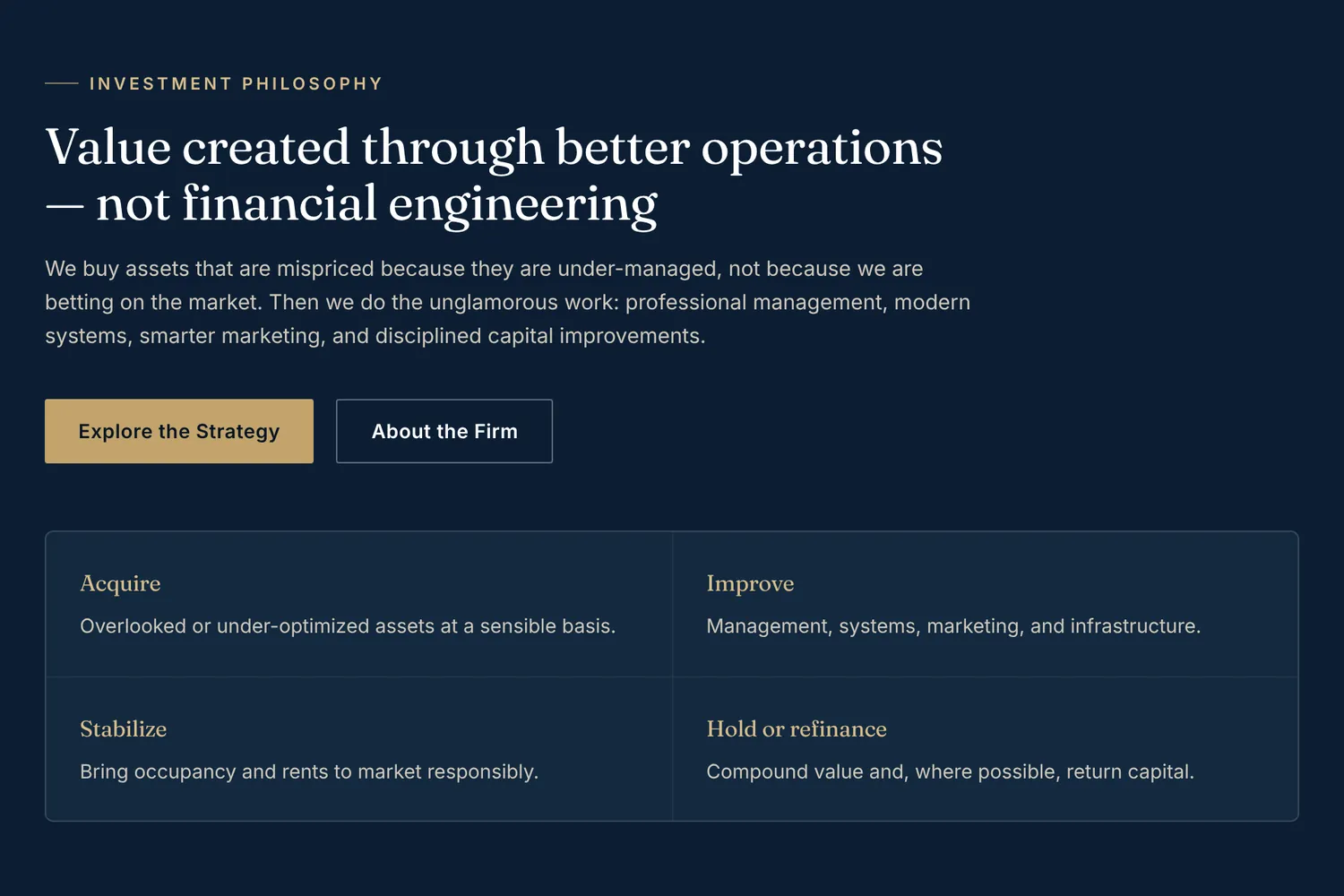
Kaizen Properties
Built here: the company website, organized around what it buys and how it operates.
Fig. 2. The operating-approach section at tablet width. Captured October 2026.
Independent products, each with its own website
Apps and web tools our founder designed and published. The websites are part of each product.

Independent product
Mobile Notary Fee Calculator
Prices mobile notary and loan-signing jobs, keeping state-capped notarial fees separate from travel, printing and add-on charges.
Mobile Notary Fee Calculator website (opens in a new tab)
Independent product
Self Storage Calculator
Underwrites a self-storage acquisition: rent roll and unit mix, operating income, lease-up, debt coverage and returns.
Self-Storage Investor Blueprint website (opens in a new tab)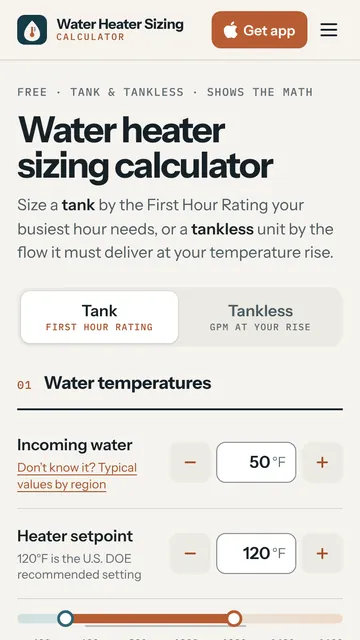
Independent product
Water Heater Sizing Calculator
Sizes a tank water heater by first-hour rating, or a tankless unit by flow and heating output, from a home’s busiest hour of use.
Water Heater Sizing Calculator website (opens in a new tab)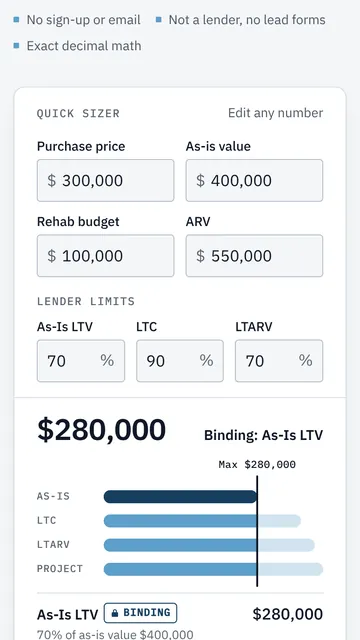
Independent product
Private Lending Deal Desk
Lender-side calculators for hard-money, private and bridge loans: loan limits, the limit that binds, points, interest and cash to close.
Private Lending Deal Desk website (opens in a new tab)
Ownership and handover
When the project ends, the website is yours: the site, its content and your domain, with nothing held back.
- Yours to keep. You own the finished site, its content and your domain. We don’t require a “website by” credit link back to us, on the site or anywhere else.
- Accounts in your name. We recommend keeping the domain and hosting accounts in your name and set them up that way, so you stay in control of them.
- A clear handover. At launch you receive a record of where the site is hosted, how to reach it, and which accounts and tools hold what.
- Nothing added silently. Hosting, the domain, paid assets such as licensed photos or fonts, and external subscriptions are clarified separately. Any ongoing care after launch is scoped and priced on its own, never folded into the project price.
Not part of this service
Excluded, whatever the scope
- Custom portals, mobile apps or proprietary booking systems.
- Complex e-commerce or custom software.
- Ongoing SEO campaigns.
- Unlimited revisions.
- Hosting, domain, paid assets, external subscriptions or ongoing care. These are clarified separately and never added silently to the project price.
Price and what moves it
Most projects fall within the published range. Where yours lands depends on the work involved, and your written scope sets a fixed price before anything starts.
What moves a project between $3,500 and $6,000
- Number of pages and how much new copy each needs
- How many distinct services or audiences the site has to explain
- Integrations with an existing booking or scheduling tool
- How much photography and source material is ready to use
- Content migration from an existing site
Outside the price
- Hosting and domain
- Not in the project price. We recommend a sensible setup during scoping, with the accounts normally in your name.
- Paid assets and subscriptions
- Licensed photos or fonts, or a paid booking tool, are clarified separately before they’re used.
- Ongoing care
- Optional, and scoped and priced separately if you want it. Never added silently.
Prices are in U.S. dollars. There’s no checkout: every project starts with a Visibility Review and a written scope.
Questions about websites
What does a website project include?
Roughly five to eight pages, scoped before work begins: service-focused copy written with you, a distinctive design built for phones first, a contact form or a connection to the booking tool you already use, basic analytics where you approve it, technical and on-page SEO foundations, and two rounds of revisions. The final scope and price are agreed in writing before we start.
What moves a project within the price range?
Typical projects fall between $3,500 and $6,000. The main factors are the number of pages and how much new copy each needs, how many services or audiences the site has to explain, any connection to an existing booking tool, how much photography is ready to use, and whether content has to move from an old site. Your written scope sets a fixed price.
Who owns the finished website?
You do. At handover the site and its content are yours, with a clear record of where everything lives and how to reach it. Google’s Business Profile guidelines say website content should be owned and managed by the business owner, and we agree. We don’t require a “website by” credit link back to us, on the site or anywhere else.
Is hosting included?
No. Hosting, the domain, paid assets such as licensed photos or fonts, external subscriptions and any ongoing care are clarified separately and never added silently to the project price. We recommend a sensible setup during scoping, and the hosting and domain accounts normally sit in your name, so you stay in control of them.
Can you build a customer portal or an online store?
Not as part of this service. Lead-Generation Websites are focused marketing sites: service pages, proof and an easy way to get in touch. Custom portals, mobile apps, proprietary booking systems, complex e-commerce and custom software are outside the scope, as are ongoing SEO campaigns and unlimited revisions. If you need one of those, we’ll say so plainly rather than stretch the project.
Will my new website rank on Google?
We can’t promise rankings. Every site gets clear page titles and descriptions, a sensible structure, fast loading and a design that works on phones, which are the foundations Google documents. Where a site ranks also depends on competition, content and many signals beyond a website build. What we do promise is a site that explains your services clearly and makes getting in touch easy.
Lead-Generation Websites